Getting Started with MMM Using Google Meridian
Executive Summary
Google Meridian is Google's open-source marketing mix model. It measures which channels drove revenue, where spend is wasted, and where the next dollar should go. It uses aggregated data, no cookies, no user-level tracking.
It launched broadly in February 2025 and has shipped consistent updates since. In February 2026, Google added Scenario Planner, a no-code interface for budget modeling that does not require Python.
It is one of the best open-source MMM frameworks available. It is also not plug and play.
What you need to run it: Python 3.11 or 3.12, a GPU, clean channel-level data going back 2 to 3 years, and someone who can configure priors, run diagnostics, and interpret outputs without breaking something.
What it gives you: Channel contribution, historical ROI, marginal ROI, saturation curves, and budget optimization scenarios.
Where it breaks down: Setup complexity, thin data at scale, and the interpretation gap between "the model ran" and "we made a good decision."
The decision in one line: Use Meridian if your team can own the full technical workflow. Use Stella's MMM if your bottleneck is execution, not philosophy.
What is Google Meridian? (The short answer)
Google Meridian is an open-source marketing mix model built by Google. It uses aggregated historical data to estimate how much each marketing channel contributed to your revenue, where spend is wasted, and where the next dollar should go.
It does not use cookies or user-level tracking. That matters because those signals are getting weaker every year and platform attribution only tells you what each platform wants credit for.
Meridian went broadly available in February 2025 after testing with hundreds of brands globally. It has shipped meaningful updates since then and is actively maintained.
It is one of the best open-source MMM frameworks available. It is also not plug and play. This guide tells you exactly what you are getting into.
Why is MMM having a moment in 2026?
Because the old way of measuring marketing is broken.
Platform dashboards tell you what Meta, Google, TikTok, and Amazon want you to believe. They do not tell you what actually caused a sale. Privacy changes, iOS 14 signal loss, retail media, CTV, podcasts, and offline channels have made attribution even messier.
Nielsen's 2025 Annual Marketing Report found 85% of marketers say they are very or extremely confident in their ability to measure holistic ROI. Only 32% actually measure traditional and digital media holistically.
That gap is the problem. Confidence without accuracy is just expensive guessing.
MMM looks at actual business outcomes across all channels at once. Not what each platform claimed. What actually moved revenue. IAB's December 2025 MMM best practices guide calls this the direction the industry has to move: multi-year inputs, omnichannel coverage, faster refresh cycles, and experimentation integration.
That is why MMM is back. Not because it is trendy. Because the alternatives stopped working.
What questions does Meridian actually answer?
- Which channels contributed to revenue over the last 12 to 24 months?
- Which channels are overfunded relative to what they actually return?
- Where does spend start producing weaker returns (saturation)?
- What is the marginal ROI of the next dollar by channel?
- How should budget be reallocated to hit a revenue target?
That last question is the whole point. Nobody runs MMM because they love Bayesian statistics. They run it because they need to make budget decisions without being lied to by platform dashboards.
MMM is not a replacement for every metric. It is a channel-level, strategy-level tool. It tells you the budget story. For campaign-level decisions, you still need incrementality testing.
How do you install Google Meridian?
Get the install command right
The package is google-meridian. Not meridian. If you see pip install meridian anywhere, that is wrong and will not install the right thing.
Per Google's official install documentation, you need Python 3.11 or 3.12. Google recommends at least one GPU (tested on V100 and T4, 16GB RAM).
Linux with GPU support:
python3 -m pip install --upgrade 'google-meridian[and-cuda]'
Verify your install:
python3 -c "import meridian; print(meridian.__version__)"
CPU-only or macOS:
python3 -m pip install --upgrade 'google-meridian'
No official GPU support for macOS. The Meridian GitHub repo and PyPI package are actively maintained. Current version as of early 2026 is 1.5.3.
How to run the Google Meridian demo
Before you touch your own data, run Google's official Meridian getting started colab.
It is a fully worked notebook using sample data. It covers installation, data loading, model configuration, diagnostics, output review, and budget optimization in sequence. Running this first is the fastest way to understand how the pieces fit before you try to plug in your own numbers.
Do not skip it. Teams that go straight to their own data without running the demo first are the same teams that end up with a model they cannot interpret.
The correct workflow order
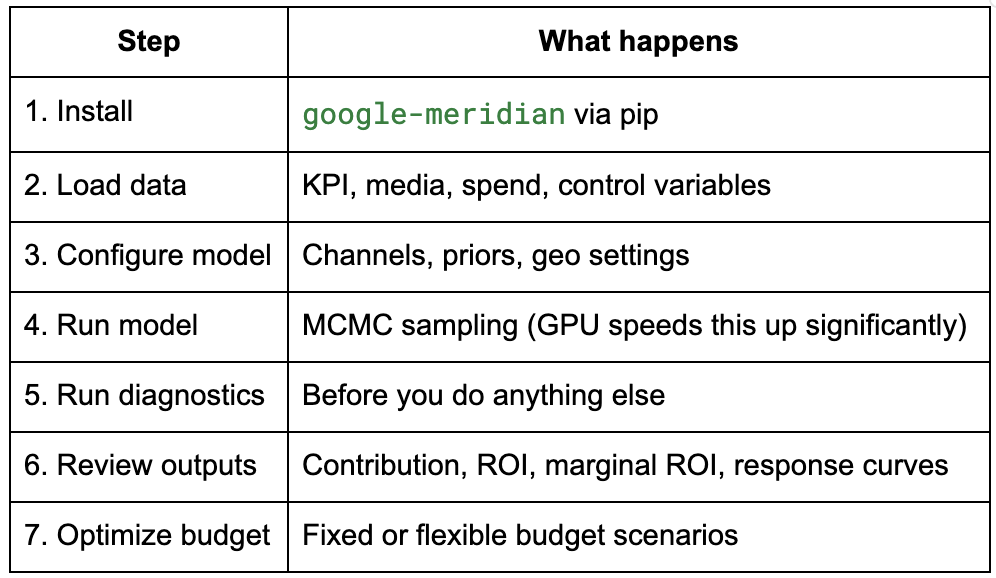
Step 5 is where most teams skip ahead and make bad decisions. Running the model is not the finish line. It is the start of the part where things go wrong.
A polished-looking budget chart from a weak model is still a weak model. Before acting on any output, read Stella's guide on how to validate a marketing mix model.
Where to find Google Meridian documentation
Everything you need is in one place. Here are the links worth bookmarking:
- Meridian overview and about page — what it is and what it solves
- Install documentation — current install commands and Python/GPU requirements
- Getting started colab (the demo) — the official worked example with sample data
- FAQs — campaign-level limits, calibration, and common questions
- GitHub repository — source code, version history, open issues
- PyPI package — latest release, version 1.5.3 as of early 2026
The documentation is genuinely good. If you are evaluating whether Meridian is right for your team, start with the FAQ. It is honest about what the tool cannot do.
What data does Google Meridian need?
This is where most teams get humbled.
Minimum data requirements
Per Google's official documentation:
- Geo-level models: at least 2 years of weekly data
- National-level models: at least 3 years of weekly data
- Monthly data only: at least 3 years
Meridian is not a shortcut for messy data. It needs consistent history and enough variation in spend to separate what worked from what just happened to coincide with a good quarter.
What goes in the model
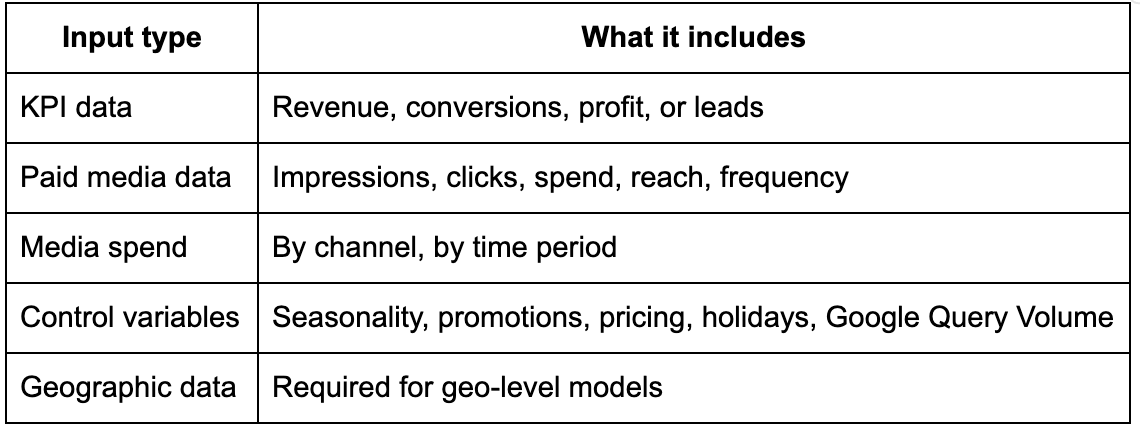
Meridian also supports organic media, non-media variables like pricing, reach and frequency data, and experiment calibration using incrementality results. That last one matters. Calibrating the model with real geo-experiment results is how you get from correlation to something closer to causality.
What Meridian cannot do at the campaign level
Google is explicit about this: Meridian is a channel-level tool. Campaign-level modeling is generally not recommended. Campaigns with hard start and end dates lose adstock memory, which corrupts the model's interpretation of carry-over effects.
MMM is for budget allocation and channel strategy. It is not a replacement for campaign-level reporting. Every team that tries to force campaign-level data into an MMM ends up with a model that looks precise and is not.
What does Meridian measure and output?
Channel contribution
Meridian estimates each channel's contribution to your KPI over the modeling period. This is the answer to the question attribution dashboards avoid: did this channel create incremental business, or did it just happen to be close to the conversion?
ROI vs. marginal ROI
ROI tells you what a channel returned historically. Marginal ROI tells you what the next dollar is likely to return at current spend levels. The second number is almost always more useful for decision-making.
A channel can have great historical ROI and still be a terrible place to add more budget if it is already saturated.
Saturation curves
Meridian models the point where additional spend produces weaker returns. This is where most budget waste hides. Not in channels that obviously do not work. In channels that used to work, still kind of work, and slowly get worse as spend increases.
Budget optimization and Scenario Planner
Meridian has built-in budget optimization for fixed and flexible budget scenarios. In February 2026, Google launched Scenario Planner, a no-code Looker Studio interface that lets marketers run budget scenarios without writing Python. This is a meaningful change for teams that want Meridian's outputs without requiring an analyst to run every scenario.
Scenario planning is not certainty. It is a better decision framework. The model helps. Judgment still matters.
For help turning MMM outputs into actual budget decisions, read Stella's guide on what to do after you run an MMM.
Where does Meridian break down?
The setup tax is real
Meridian is open-source. That is not the same as easy.
You need Python proficiency, data engineering skills, understanding of Bayesian priors, the ability to run and interpret diagnostics, and ongoing capacity to refresh the model as new data comes in. Google recommends a GPU. The setup is designed for technical teams.
That is not a flaw. It is the cost of owning a flexible, transparent tool. Open-source gives you control. It also gives you full responsibility for getting it right.
Data thinness is a real ceiling
Google's own documentation includes an example: two years of weekly data, 12 media channels, 6 controls, 8 knots. Result: roughly 4 data points per estimated effect. Google calls this a low sample-size scenario.
Teams say "we have two years of data." That might be true. But do you have enough usable data to reliably estimate everything you are asking the model to explain? That is a different question and most teams do not check it before running.
The interpretation problem
This is the most common failure mode.
The model runs. The charts look credible. Someone grabs the highest-ROI channel, shifts budget, and skips the part where they check uncertainty intervals, saturation levels, and whether the priors were reasonable.
That is not measurement. That is spreadsheet theater with Bayesian packaging.
Good MMM outputs require someone who can tell the difference between a result that is real and a result that just looks clean. Without that person, you are making expensive decisions based on a sophisticated-looking guess.
Read Stella's guide on why most media mix models fail for a breakdown of where this goes wrong most often.
Meridian vs. a managed MMM: when does each make sense?
Here is the honest version of this comparison. Not a sales pitch. An actual decision framework.
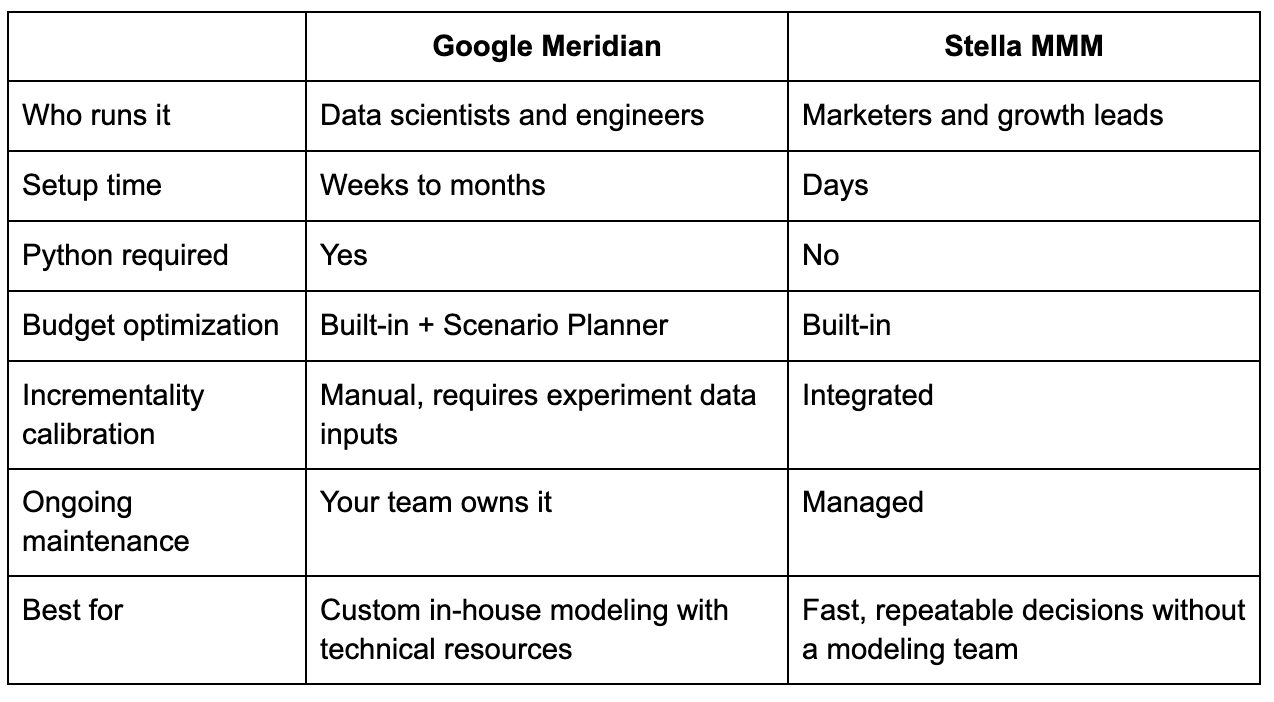
Use Meridian if: Your team has data engineers, Python proficiency, statistical judgment, and the time to own model configuration, diagnostics, calibration, and ongoing refreshes. If you want full transparency and control over every modeling decision, Meridian is one of the best open-source frameworks available.
Use Stella if: Your bottleneck is not philosophy. It is execution. Most teams do not need another notebook. They need a repeatable way to understand what is working, what is saturated, what is incremental, and where budget should move. That is what Stella's media mix modeling platform is built for.
The real choice is build vs. use. If you want to build and own the MMM layer, Meridian is the right tool. If you want MMM to drive faster budget decisions without turning your marketing org into a modeling team, Stella is the cleaner path.
Pair MMM with incrementality testing
MMM tells you the budget story at the channel level. Incrementality testing tells you what actually caused lift in a specific campaign or channel at a specific moment.
You need both. MMM without incrementality calibration is correlation dressed up as insight. Incrementality testing without MMM gives you campaign-level answers but no strategic budget picture.
Pairing them is where measurement actually becomes useful. Read our post on incrementality experiments vs. A/B tests for the full picture on which testing method fits which question.
Is Google Meridian worth using?
Yes. If you know what you are signing up for.
Meridian is a serious, transparent, actively maintained open-source MMM. It is the right tool for teams with the technical resources to own it. It is not a plug-and-play solution and it is not a shortcut for bad data or limited bandwidth.
The goal is not to run a model. The goal is to make better budget decisions.
Use Meridian if your team can own the full workflow. Use Stella if you want the output without building the infrastructure to get there.
See what MMM looks like when it is built for marketers, not data scientists. See how Stella's MMM works.